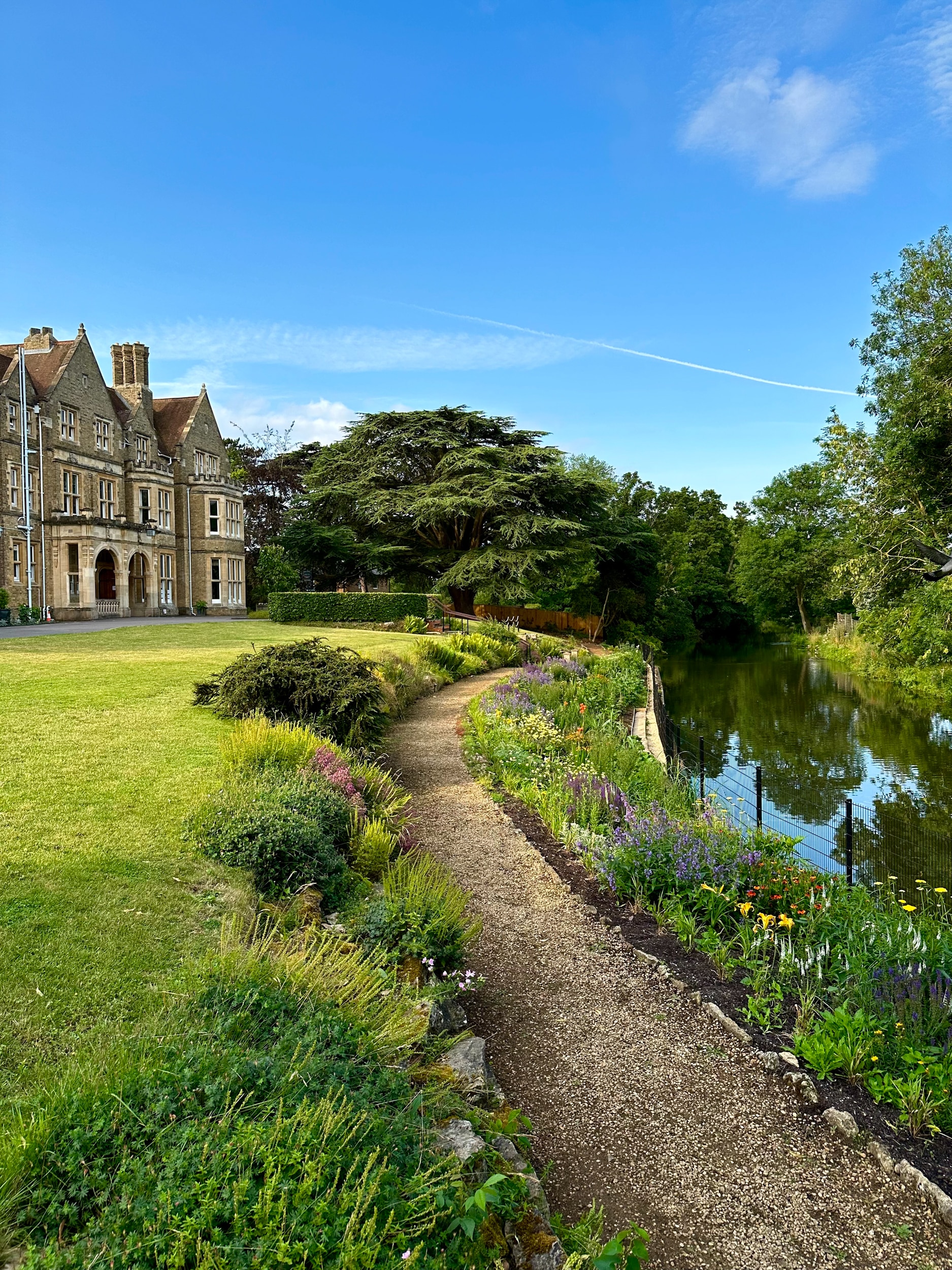
St Hilda's College
Congratulations to all our current offer-holders!
If you selected Oxford as your first choice on UCAS, pending your assessments and results, we look forward to welcoming you to St Hilda's College in October 2026! Before you arrive, you may have some questions which hopefully will be answered below. This webpage will be updated regularly with important information, so please make sure that you check it frequently. Remember, if you can't find the answers here, you can always email us. Please make sure you include your UCAS number (no dashes or spaces) and your full name when you contact us. An A-Z list of helpful information is available below.
This webpage is updated regularly with important information, so please make sure that you check it frequently.
Last updated 06.05.2026
- Accommodation and arrival/Freshers' Week
-
Most students will move into their accommodation on Monday 5 October 2026. However, for international students there is some flexibility. If you wish to arrive on the weekend of the 3/4 October, please contact our Accommodation Manager, Nicky Charles (nicky.charles@st-hildas.ox.ac.uk) who will look at arranging this for you.
All first years are guaranteed College accommodation. You do not need to apply for a room for your first year. Students do not share rooms; each student has a room to themselves. For more details about accommodation, please visit our undergraduate accommodation webpage. For more information about St Hilda's and living here, please visit our dedicated webpages about living in College that cover topics from food and drink to health and welfare.
If you would like to bring electrical equipment, please read page 41 of the Student Handbook which details what equipment is allowed and not allowed in bedrooms due to fire safety regulations.
- Certification of qualifications already achieved
-
Your offer letter may include the following:
Since you have already met part or all of these conditions, you must provide original certificates or legally certified copies to the College by 1 April for any requirements already met.
This may be because you have completed all of the qualifications outlined in the offer, or just some of them. For example you may have taken an A-level in Year 12, but are taking more in Year 13. In this case we would need to see evidence of the completed qualification. If you need to provide us with evidence of your exam results, please read the following guidance carefully.
This section also applies to those of you sitting qualifications other than the IB, APs, and Scottish Highers. This process also applies to some types of English Language qualifications (see section on English Language Requirements below.) It applies to some already-taken A Levels.
At St Hilda's, we ask that you submit certified copies, not original certificates. Your school or teacher can legally certify a copy of your certificate. To do this, the copy of your certificate must be:
- in colour (black and white will not be accepted), and
- signed with the phrase "I verify that this is a true copy of the original" by your school exam office, UCAS referee, or teacher, and
- dated by your school exam office, UCAS referee, or teacher, and
- stamped by your school exam office, UCAS referee, or teacher with your school's official stamp
Once this has been done, please ask your school or teacher to email us the certified copies from their work email address with you (the offer-holder) copied into the email (i.e. you must also be sent the email at the same time as it is sent to us. You can be included in the 'to' field OR the 'cc' field.). Emails that do not have offer-holders copied in, using the email address associated with their UCAS application, will not be accepted. Legally certified copies sent from private email addresses (e.g. from a gmail, hotmail, yahoo account) will not be accepted.
On the rare occasion that it is not possible for your school or college to certify your certificates, please follow the UK Government's guidance on how to certify a document. Certificates that have not been certified will not be accepted. If you intend to use a certification method not specifically mentioned on this page, please get in touch with us before proceeding, to make sure it's something we accept.
If your certificate is not in English, you will need to provide a translation of the certificate(s) into English which is either:
- issued and stamped by the institution that issued your transcript, or
- translated by a professional translator and visibly certified – ie signed and stamped – by the professional translator or an authorised notary.
Some already-achieved A Level & BTEC results will be pushed through to our systems automatically in early March. If this happens, and we've not already received certified copies form your school, we will let you know. This is most likely to happen if you applied to UCAS in a previous cycle.
IB students can share their already-achieved results with us via the Request for results service site. You don't need to do this if you're due to get your results in the summer of 2026. If your results are already out/due before this, please follow this process. Please drop us an email to let us know you've done this. (Or you can follow the manual process detailed above.)
If you are taking American qualifications such as APs, please see the section on this page titled 'College Board'.
If you have questions about certifying your certificates, please contact us by email.
- CollegeBoard
-
If you have taken SATs or AP tests, please send your results via CollegeBoard to the University of Oxford. The relevant central University team will then distribute this to us. Please also tell us that you've done this.
Please don't send English Language documents through College Board. Please see the section on ELQs below.
- Confirmation
-
In August, once we have the results of all candidates, we will email you confirming whether you have fulfilled the conditions of your offer or not. This usually happens the same day that the UK A-level results are released. More information about confirmation can be found here.
Each year, UCAS and universities and colleges are given early access to results under strict embargo arrangements with the Scottish Qualifications Authority (SQA) and the Joint Council for Qualifications (JCQ). An embargo period covers the defined period of time where early access to embargoed examination results is given. This allows universities and colleges to prepare and make decisions by the official publication dates of exam results in August. During the embargo periods universities and colleges cannot discuss an applicant’s individual status with them, or their schools. The main embargo period normally lasts about a week and ends on A-level results day. There is an earlier embargo period around the release of Scottish qualifications. If you contact us during these periods, we will not be able to reply to you. Both of these embargoes apply to all offer-holders, even those who already have their exam results.
If you are a post-qualification offer-holder (i.e. you completed all relevant qualifications before you applied and already have the certificates/results), we will process your documents after the April deadline; if there are any problems, we will contact you. You will not receive an "official" email confirmation from us until August, as described above. However, your UCAS page will update soon after your documents have been processed. You will need to confirm your offer from Oxford as your Firm choice on UCAS before we can process your documents, and this can only happen once you have received notifications from all the other institutions you applied to.
If you are an open offer holder, this is when we will confirm which college you will be going to.
If you are an offer-holder, who has missed the grades outlined in the conditional offer, we will email you on the morning of A Level results day with information on the outcome of your application. Please bear with us - it can take a good hour or more after the embargo ends to get all of the emails out to all of our offer holders. Phoning us during this period will only slow things down.
If you have missed your offer, please email us ASAP - and no later than the end of play on the Monday after A Level results are released - if you are planning on getting a remark. Please indicate which subjects you are getting remarked, and how many marks off you are off your target grade. Where evidence of a re-mark is received by 5 September, colleges endeavour to honour the applicant's place for their offered year of entry wherever possible. After this date, colleges are allowed to offer a deferred place instead, should quotas be full at that stage. We will provide more information on this in response to your email notifying us of the re-grade. This information applies to all types of St Hilda's offer holders, including open and deferred.
- Dates of terms
-
Oxford's year is divided into three terms and three vacations. The three terms are:
- Michaelmas Term (October - December)
- Hilary Term (January - March)
- Trinity Term (April - June)
The dates for each term can be found here. Within each term, a "Full Term" of eight weeks is the main teaching period. New students are required to arrive for Michaelmas Term by the Monday before Full Term. More details about arriving at College will be sent to you nearer the time.
Also see the section on accommodation, above, for further information about arrival dates for Freshers' Week.
- Deadlines and timelines
-
Below is a quick reference of the upcoming deadlines (not all deadlines apply to every offer-holder):
Timeline for Undergraduate Offer Holders Task Deadline For post-qualification offer holders, send certificates to the Undergraduate Admissions Office 1 April You may receive a Criminal Declaration form from the Undergraduate Admissions Office - one of the University's central teams. End of March normally; see instructions on email. Reply to your offer on UCAS 6th May or 3rd June Financial Declaration Form completed and returned 30 June Receive your reading list By the end of June English language qualifications completed and certificates sent to the Undergraduate Admissions Office 31 July All qualifications completed Mid-August (when A-level results are released) Visas - we will contact offer-holders requiring a visa Mid-August (shortly after A-level results are released) - Declining your offer
-
If you decide that you do not wish to take up your place at St Hilda's College, please email us once you have declined your place on UCAS.
- Deferring
-
If you have been offered a place to study at St Hilda's College, the course and start date cannot be changed, unless there are serious exceptional circumstances. If you wish to discuss this further, please email us.
- Disability support
-
The University's Disability Advisory Service provides information and advice on disability issues and facilitates support for those with, for example, sensory or mobility impairments, long-term health conditions, specific learning difficulties, autistic spectrum conditions or mental health difficulties.
Offer-holders who have declared a disability on their UCAS form will be contacted directly by the Disability Advisory Service. This normally happens in the spring.
There will be further opportunities for offer-holders to tell us about their disability in August. Those who have indicated that they need support will be contacted by our Disability Coordinator, Becky Unwin, prior to arrival in October.
- Dropping A-level subjects
-
If you are taking A-levels, our offer will be for 3 A-levels. If you are taking 4 A-levels or an EPQ and would like to drop a subject after receiving an offer from us, the College will not give you direct advice about this. We highly recommend that you discuss this further with your teachers/school as they will be able to advise you and they will also know about the other offers you have received. For offers here at St Hilda’s, it is your decision how to fulfil the requirements of your offer (including the English language requirements) but you must achieve the requirements of your offer to gain a place here.
If you decide to drop a subject, please email us.
- Embargo period
-
Important embargo information: Each year, UCAS and universities and colleges are given early access to results under strict embargo arrangements with the Scottish Qualifications Authority (SQA) and the Joint Council for Qualifications (JCQ). An embargo period covers the defined period of time where early access to embargoed examination results is given to universities. This allows universities and colleges to prepare and make decisions by the official publication dates of exam results in August. During the embargo periods universities and colleges cannot discuss an applicant’s individual status with them, or their schools. The main embargo period normally lasts about a week and ends on A-level results day in mid-August. There is an earlier embargo period around the release of Scottish qualifications. This is normally early August. If you contact us during these periods, we will not be able to reply to you. Both of these embargoes apply to all offer-holders, even those who already have their exam results.
- Email address
-
If you have a school email address registered on UCAS, we ask that you change this to a personal one as your school email address will stop working after you have sat your exams and we will not be able to contact you. First, change your email address on UCAS. When you update it on UCAS it's best to replace the old email address, rather than adding an extra one. Then please also email us from your old account to confirm this change. Please copy in your new email address into the email. It is helpful if you can include your UCAS number when you contact us.
- English language requirements
-
You may find that your offer letter states:
You are also required to meet the English language requirement as detailed online by 31 July.
Some offer-holders may be considered for an exemption from sitting the English Language requirement. Exemptions from this English Language requirement will be considered for those who:
- are studying (or have completed) the International Baccalaureate programme, if it is taught in English or the Singapore Integrated Programme (SIPCAL)
- have been educated full-time in English for at least the two most recent years before applying and who remain in full-time education in this language until completion of their schooling. This means that a minimum of three years of your most recent education must have been in English before the start of your Oxford course
Please note, this is for consideration only and is not automatic. If you think you might be exempt from these requirements, please read the guidance and then fill out the waiver form and email it to us.
If you have taken IELTS, TOEFL, or Cambridge Certificate of Advanced English (CAE), please send a PDF certificate of these directly to us via email. It's helpful if file name is in the format LASTNAME Firstname - QUALIFICATION ACRONYM.
All other certificates will need to be legally certified copies. Please see the section titled 'Certification of qualifications already achieved' above, for information on how to do this.
Unless your English language certificate has an expiry date, the time when this was issued does not affect its validity. If your certificate does have an expiry date, you should ensure that it is valid at the point when you provide it to your college as evidence of English language proficiency.
If you have problems fulfilling this requirement or if you have any questions, please email us well before the deadline.
- Feedback & test scores
-
Please note, we do not provide feedback to successful candidates. However, if you would like to find out more about how test scores are released, and a summary of the admissions round for your subject, please see our feedback page.
- Fees and funding
-
Course fees must be taken into consideration by all candidates, as well as the living costs of going to University. You can find the Undergraduate Fees and Funding Guide for 2026 entry here. All offer-holders should read this document very carefully.
If you are interested in undergraduate scholarships, please make sure you visit the Oxford bursaries and scholarships for 2026 entry webpage for more information, including closing dates and eligibility criteria. You may also find the Fees, Funding and Scholarship Search helpful.
Oxford offers one of the most generous financial support packages available for UK students, providing around £8 million of financial support to undergraduates from lower-income households. Around 1 in 4 UK students currently receives an annual, non-repayable bursary from Oxford. If you are UK student, you may be eligible for a non-repayable bursary.
For 2026-entry, UK resident students commencing their first undergraduate degree with a household income of £32,500 or less will be invited to become Crankstart Scholars. This not only provides enhanced funding but other opportunities such as volunteering and summer internships. You do not need to apply to the Crankstart Scholarship. From mid-September, all students who have been resident in the UK for a period of at least three years (not for the purposes of education), commencing their first undergraduate degree and with a household income of £32,500 or less will be offered a Crankstart Scholarship. The household income assessment used will be that carried out by your regional funding agency, eg Student Finance England.
The following undergraduate scholarships are available; for further information, please click on the scholarship name below to be taken to the relevant page of the website.
Candidates can apply for the undergraduate scholarships listed above using the registration form, providing they are eligible. Applicants who wish to be considered for more than one of the above scholarships only need to submit one form to be considered and do not need to submit separate applications for each scholarship. Applications for these scholarships normally open in January just after offer letters are sent out. Deadlines vary, but are often in February.
There is also information available on ideas for external scholarship opportunities. There are some further St Hilda's-specific funding opportunities, but these are mostly applied for once you are on course.
See also the Financial Declaration Form section below.
- Financial Declaration Form (FDF)
-
By the end of March, we expect most offer-holders will have been be sent an email notification to tell you that your Financial Declaration Form (FDF) form is available to view and complete. This FDF form asks you for details on how your studies will be funded and must be returned to us by 30 June. Detailed instructions of how to upload your documents via a student self-service portal will follow.
If you are applying for a loan via the Student Loans Company (SLC) or other funding sources, the application process can take a while, so please start the application process as soon as possible. Student Finance England normally open applications in late March. You will be asked to upload the evidence of your loan application to the portal as part of filling out the FDF. If you can't find this "Financial Notification" document (also known as a Student Finance Breakdown or Notification of Entitlement) and you've applied to Student Finance England, try logging into your account on their website, and looking under "Letters and emails". It's normally a two page letter (we need both pages) and a page titled 'University or College Payment Advice', that has a big table in the middle and a barcode top left.
FDFs must be signed by offer holders, not by teachers/parents/guardians. Offer holders can send queries about the FDF via the portal. The magic link to FDFs expire 3 months after they are sent out, so you you may see us re-sending it to you, if you've not already completed it.
Please don't attempt to fill out the forms using a mobile phone - it works much better on laptop/desktop.
Please read the following documents carefully:
*About the FDF
*Financial Declaration Form: Essential Information Undergraduate Courses – Full-Time 2026/27Please note the following, very important information. These are the bits that offer-holders most-often get wrong when filling out the for & returning the required documents.
-
- (i) Home fee status (first UG degree)
If you have applied for a tuition fee loan, you must submit a copy of your Financial Notification (Student Finance Breakdown) from your funding agency so that your college is aware of any UK government fee support that you will receive. (This is the document you get once your loan is confirmed by the relevant SLC.) The evidence should be submitted as an upload into the FDF form prior to submitting it. If you indicate that you intend to pay your tuition fees with a SLC student loan, but submit the form without the Student Loan Company evidence the form will be returned to you.
- (i) Home fee status (first UG degree)
If the form has been returned to you, as it is missing the student loan documents: On the second page of your form, under ‘Funding Details’, you have previously chosen your type of funding as ‘Student Loans Company (SLC)’. Below this type of funding, you will see the funding amount, and below this there is a question: Do you already have a copy of your Student Finance confirmation letter from your regional funding body for the first year of the course? You have currently selected ‘No’ on the drop-down answer options for this question. Please change the answer to ‘Yes’.
Once you have selected ‘Yes’, wait for the form to update. You should now see a new question at the bottom: Please submit a copy of your Student Finance Letter with an ‘Upload Document’ button next to it. Click this button and follow the steps to upload a PDF copy of your funding letter from your laptop or phone. Once you have uploaded the letter, scroll to the bottom of the form and submit it again.If it is less than a week to go before the deadline, and you still don't have your Student Loan Company documents, please complete the form and upload the evidence that the SLC has been applied for. We can use this as a holding document until the Financial Notification/Student Finance Breakdown documents are issued to you.
- (ii) Overseas fee status,
You are required to submit copies of documentation detailing any scholarships, loans, savings etc. which you will use to meet your course fees in Year 1 only of your course. If your funding for your course fees for Year 1 is
coming from multiple sources, you must provide relevant evidence for each source. All supporting documentation should be provided in written English; where an original is not available in English, both the
foreign language document and a translated copy are required.
• Scholarship or Award – you must provide official communication from the award sponsor, confirming the specific amount of funding that will be provided towards your Year 1 fees.
• Family Funded / Private Sponsor / Self-Funded – If you expect a grant or loan from parents or other
persons, you should include a letter from them accepting responsibility for meeting your Year 1 fees, confirming the specific amount of funding provided. We would normally expect the letter to be dated, contain the sender's contact details, and contain a signature. This letter should be accompanied by supporting evidence, from an employer or professional adviser (such as an accountant or lawyer) showing that
sufficient funds are available. Bank statements on their own are not normally sufficient. However, if bank statements are used, we expect to see that the level of funding needed has been consistently available for 3 months.
• Please convert all non-UK currency into GBpounds (£) and provide information on which exchange calculator was used and when. (A note of the date, the URL and the exchange rate is fine.)
• There is no need to provide a birth certificate/proof of your relationship with your parent.If you are using private funds to pay for your tuition, accommodation etc, rather than governmental student loans, once you have arrived and enrolled, the St Hila's finance team will send you an invoice which has all the details of how and when to pay. You might find the College's payment policy useful.
Information on how fee status is determined is available on the main university website.
If you are an open offer holder your FDF will automatically be transferred to your new college in August, if applicable.
-
- Embargo period
-
Please double-check that your name appears on UCAS exactly as it appears on your passport. If they don't match this can cause problems later, especially with visas. The earlier we can get it fixed, the better.
Your preferred name is how we will normally address you in an email. For example, if your name is 'Jennifer Jane Jones', but you would like to be called 'Jenny' then put 'Jenny' in the preferred name box. Please don't include your last name in the preferred name field.
If you do update your name on UCAS please do drop us an email so we can make sure all the records are updated properly.
- Offer-holders' day
-
We will be hosting our offer-holders' day at St Hilda's on Saturday 28 February 2026. Detailed information about the Offer-Holder Day, including the RSVP form is now available. Please respond to our invitation, even if it is to let us know you can't join us, by Sunday 1 February 2026.
We don't plan to offer an alternative on-line event. Please see the information below about visiting the college if you can't attend the offer-holders' day.
- Offer-holders' newsletter
-
St Hilda's offer-holders' newsletters will be circulated periodically by email. The first edition of the newsletter can be found here.
Please also refer to this guidance for new students.
- Pre-arrival paperwork: after you've accepted your offer
-
By completing all relevant tasks in the checklist given on the ‘before you arrive’ page, you can ensure your arrival at the University goes smoothly. Note, you won't be able to do this until August/September! But once the paperwork is issued to you, please do return it very swiftly.
You will be sent detailed instructions on each of the following steps, but to give you an idea of what's coming up:
If you accept the University’s offer of a place you will enter into a contract with the University. A copy of the contract can be found here. Once you have met the conditions of your offer, you will be sent a University card form to sign and return together with a passport photograph and the aforementioned contract. (We normally send this out in mid-August; on A-level results day.) This photo, which is a head-shot, will be used on your university ID card - more widely known as your 'Bod card'. This photo is likely to be there for the duration of your degree, so think carefully about what you submit. If you don't already have a passport photo available, do get one done, so it's ready to use in mid-August.
If you need a student visa, and you were between 16 and 18 years old at the point you applied, you would have supplied a parental consent document as part of the application. You need to upload a copy of this letter (unchanged) as part of submitting your St Hilda's Freshers' form.
You're encouraged to return these forms ASAP - although the deadline is normally the start of September, different teams across the university process your data, and it can take a while. The later you send back the forms, the further down the queue you are. The forms can be completed even if you don't yet have your student visa details. Note: your student number is different from your UCAS ID.
Once you have signed and returned your University card form, and in advance of the start of term, you will be sent your University of Oxford Single Sign On IT account details, giving you access to online resources including your Oxford email address. This normally happens from the start of September. (The quicker you complete the forms, the earlier you get it.) If you took part in Opportunity Oxford online you should already have your Single Sign On details, so you are unlikely to get a notification email in September.
Once you have your Single Sign On details, you should complete the first step of your University registration by verifying your details online using Student Self Service before you arrive. Details of each of these steps are given on the above webpage.
You complete the second stage of registration in person, on the Monday of Freshers' Week. This is when you collect your Bod Card. This final stage of registration will allow you to access further parts of the Student Self Service portal. This includes being able to download an enrolment certificate that is often needed to open a student bank account.
Please also see the guidance on Visas, Financial Declaration Forms and Deadlines & Timelines sections of this page. International students are encouraged to also look at the advice from the central university; the bank account information is particularly useful.
- Reading lists
-
Most tutors will set their incoming freshers some pre-reading to do over the summer. The pre-reading is now available here.
- Student handbook
-
Both the College Student Handbook and the University Student Handbook are updated each summer and are required reading for all students. They contain important information to help guide you through your time here. You will be sent the 2026 entry versions in August; in the meantime, the 2025 entry version of the College Student Handbook can be found here: Student Handbook. It contains lots of really useful information that will help make your transition to Oxford a lot smoother and easier. Please do read through it carefully.
- Types of offers
-
We make different types of offers. If you have any questions about your offer or what certain terms mean (e.g. an Open Offer, Opportunity Oxford Offer etc.) please visit the University's Decisions webpage. You might also find the guidance from UCAS on 'understanding your application status' useful.
- Visas
-
If you require a student visa, please read through the following University webpages:
- Visa and Immigration
- Before you arrive
- CAS numbers
- Applying for your Student visa from outside the UK
The University's central visa team have a useful self-service enquiry form if you have general questions.
Please note, CAS numbers can only be processed once you have completed all parts of your offer (including your Financial Declaration Form and English Language requirements). This is normally in August.
A-level results week is a very busy time for us. If you get your A Level results in mid-August, it will take us a few days to get to sorting out your CAS. Please be patient.
If we have contacted you about needing a visa, but you don't believe you need one, please provide evidence of your visa status, via email, so that your records can be corrected. This often happens if you have Indefinite Leave to Remain (ILR) in the UK.
Students aged between 16 and 18 years of age at the time of their visa application (not at the time they start studies at Oxford) must submit a parental consent letter with their visa application. A template letter is provided for this purpose and the college will need to retain a completed copy of the letter. You will be asked to upload a copy as part of completing the St Hilda's Freshers Form in August prior to your arrival. See the section of this page titled 'Pre-arrival paperwork'.
Some students may be required to complete an ATAS certificate; the Undergraduate Admissions Office will contact you if you need to do this. [Update: all relevant students have now been contacted].
If you need a Visa, and you've changed your passport since you made your UCAS application, please send over a scan/photo of your new passport. This will speed up the process of getting your CAS generated for you. Please email, the front (outside) page AND the page(s) which have your personal details on them.
- Visiting St Hilda's College
-
If you are unable to join us for the the Offer-Holders Day, and you would like a tour or to visit St Hilda's College during weekdays, please email us. Where staff are available, we will offer a guided tour. (We can normally accommodate weekdays, but not weekends, although you are welcome to do a self-guided tour at a weekend.)
To visit the college, please head to the Lodge entrance which is on Cowley Place. There is an intercom where you can speak to the Lodge staff and they will open the gate. We are unable to offer car parking for tours.
- Writing an email
-
When emailing us, please include your full name and UCAS number. It is helpful if you also mention your course. A standard format for an email is as follows:
UCAS ID:
Dear/Hello/Good morning/Good afternoon,
[Email message here]
Kind regards/Best wishes/Yours sincerely,
Your name
We are a very small team who monitor this email address. You will normally receive a response from Hannah or Sophie.